
How to Build a Compelling College Application Profile
Why Your Profile Matters More Than Perfect Grades

Every year, thousands of high-achieving students with 4.0 GPAs and near-perfect SAT scores get rejected from top colleges. Meanwhile, students with seemingly “average” statistics get accepted to Ivy League schools. What separates them? A compelling application profile.
A college application profile is more than a collection of achievements—it’s a cohesive narrative that answers one critical question: Who are you, and why do you belong on our campus?
Admissions officers at selective schools aren’t just looking for smart students. They’re building a diverse class of individuals who will contribute to campus culture, pursue meaningful research, lead organizations, and make an impact after graduation.
In this guide, we’ll show you how to build a profile that doesn’t just list your accomplishments, but tells a story that makes admissions officers want to advocate for you.
The Foundation: Understanding What Colleges Actually Want
Before diving into strategy, it’s essential to understand the holistic review process. According to admissions experts, colleges evaluate applications across four key dimensions:
1. Academic Excellence and Intellectual Curiosity
Your transcript tells a story about your academic journey. Colleges look for:
-
Rigorous coursework: AP, IB, honors, or dual enrollment courses that challenge you
-
Upward trajectory: Improvement over time matters more than perfection
-
Contextual performance: How you performed relative to what’s available at your school
Key insight: A student who takes the hardest courses available and earns B+s often impresses admissions officers more than a student who takes easier classes for straight As.
2. Meaningful Impact and Leadership
Colleges want to see that you’ve made a difference in your communities, not just participated in activities. They value:
-
Depth over breadth: Sustained involvement in 2-3 activities beats surface-level participation in ten
-
Leadership progression: Moving from member to officer to founder shows growth
-
Measurable impact: Quantifiable results (raised $5,000, served 200 people, increased membership by 40%)
3. Authentic Character and Values
Your essays, recommendations, and interviews reveal who you are beyond achievements:
-
Personal growth: How you’ve evolved through challenges
-
Intellectual vitality: Genuine curiosity and love of learning
-
Community contribution: How you help others and give back
4. Distinctive Perspective and “Hook”
Top colleges receive thousands of applications from qualified students. They need reasons to choose you:
-
Unique experiences: Background, challenges overcome, unusual talents
-
Specialized expertise: Deep knowledge in a specific area
-
Diverse perspective: How you’ll add to campus conversations
The Ivysion Framework: Building Your Profile with Purpose
At Ivysion, we’ve developed a structured approach to profile building that transforms scattered achievements into a compelling narrative. Here’s how to apply it:
Phase 1: Self-Discovery and Interest Mapping (Grades 9-10)
The Problem: Most students join clubs and activities without understanding why, creating a disjointed profile.
The Solution: Start with structured self-assessment.
Action Steps:
-
Identify your “spike” areas: What subjects make you lose track of time? What problems do you naturally want to solve?
-
Map your current activities: List everything you’re involved in and rate your genuine interest (1-10) and impact level (1-10)
-
Find the gaps: Where do your interests and current activities misalign?
-
Strategic pruning: Drop activities scoring below 6 in genuine interest to free time for meaningful pursuits
Example: Sarah loved environmental science but was spending most of her time in debate club because she thought it “looked good.” She switched to leading her school’s sustainability initiative, conducted independent water quality research, and eventually published her findings—creating a cohesive environmental profile that got her into her dream program.
Phase 2: Strategic Activity Selection (Grades 10-11)
The Problem: Students spread themselves thin across too many activities without achieving depth.
The Solution: The 3-Pillar Activity Framework.
Build your profile around three interconnected pillars:
Pillar 1: Academic/Intellectual Pursuit
-
Advanced coursework in your interest area
-
Independent research or projects
-
Academic competitions (Science Olympiad, debate, math league)
-
Summer programs that deepen expertise
Pillar 2: Community Impact/Leadership
-
Leadership roles in clubs or organizations
-
Community service tied to your interests
-
Advocacy or awareness campaigns
-
Mentoring or teaching others
Pillar 3: Personal Development/Creativity
-
Artistic or creative pursuits
-
Athletic achievements
-
Entrepreneurial ventures
-
Unique hobbies that demonstrate character
Key Principle: These pillars should interconnect. If you’re interested in healthcare, your academic pillar might include AP Biology and a medical summer program; your impact pillar could be volunteering at a hospital; your personal pillar might be a health blog you started.
Phase 3: Narrative Development and Documentation (Grade 11)
The Problem: Students wait until senior year to think about their story, missing opportunities to shape their narrative.
The Solution: Proactive story crafting and evidence collection.
Create Your “Application Portfolio”:
-
The Brag Sheet: Document every achievement, award, and recognition with specific dates and details
-
The Impact Log: Record quantifiable results from your activities (funds raised, people helped, improvements made)
-
The Growth Journal: Reflect on challenges faced, lessons learned, and how you’ve evolved
-
The Recommendation Prep: Identify teachers who can speak to your intellectual curiosity and character; provide them with your portfolio
Develop Your Personal Brand:
Answer these questions to create your “bumper sticker”—the one-sentence summary you want admissions officers to remember:
-
What problem do you care about solving?
-
What unique skills or perspectives do you bring?
-
What evidence proves your commitment?
-
How have you grown through this pursuit?
Example bumper stickers:
-
“The self-taught programmer who developed an app to help visually impaired students navigate campus”
-
“The first-generation student who created a college prep program for her immigrant community”
-
“The athlete who used sports analytics to improve team performance and now wants to study data science”
Phase 4: Application Execution (Grade 12)
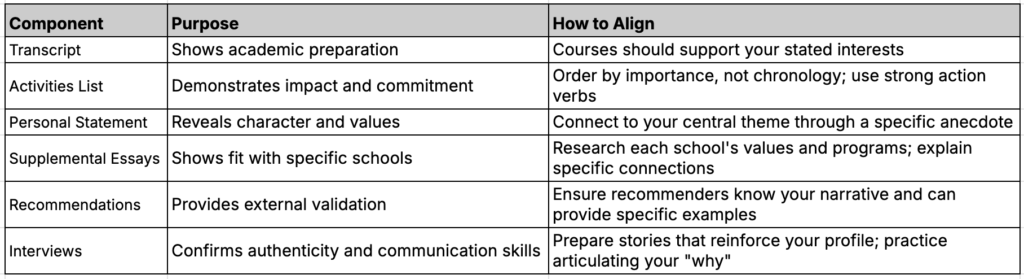
The Problem: Students treat application components as separate tasks rather than parts of a cohesive story.
The Solution: Strategic alignment across all materials.
Your Application Should Tell One Story:
About Ivysion College & Admissions Consulting
Ivysion helps students think with initiative and purpose. Our grade-based consulting programs provide structured guidance from middle school through college enrollment, ensuring students develop academic excellence, leadership depth, and compelling personal narratives. With experienced consultants and a focus on outcomes, impact, and recognition, we guide students toward projects, research, competitions, and real-world experiences that create profiles colleges understand and value.